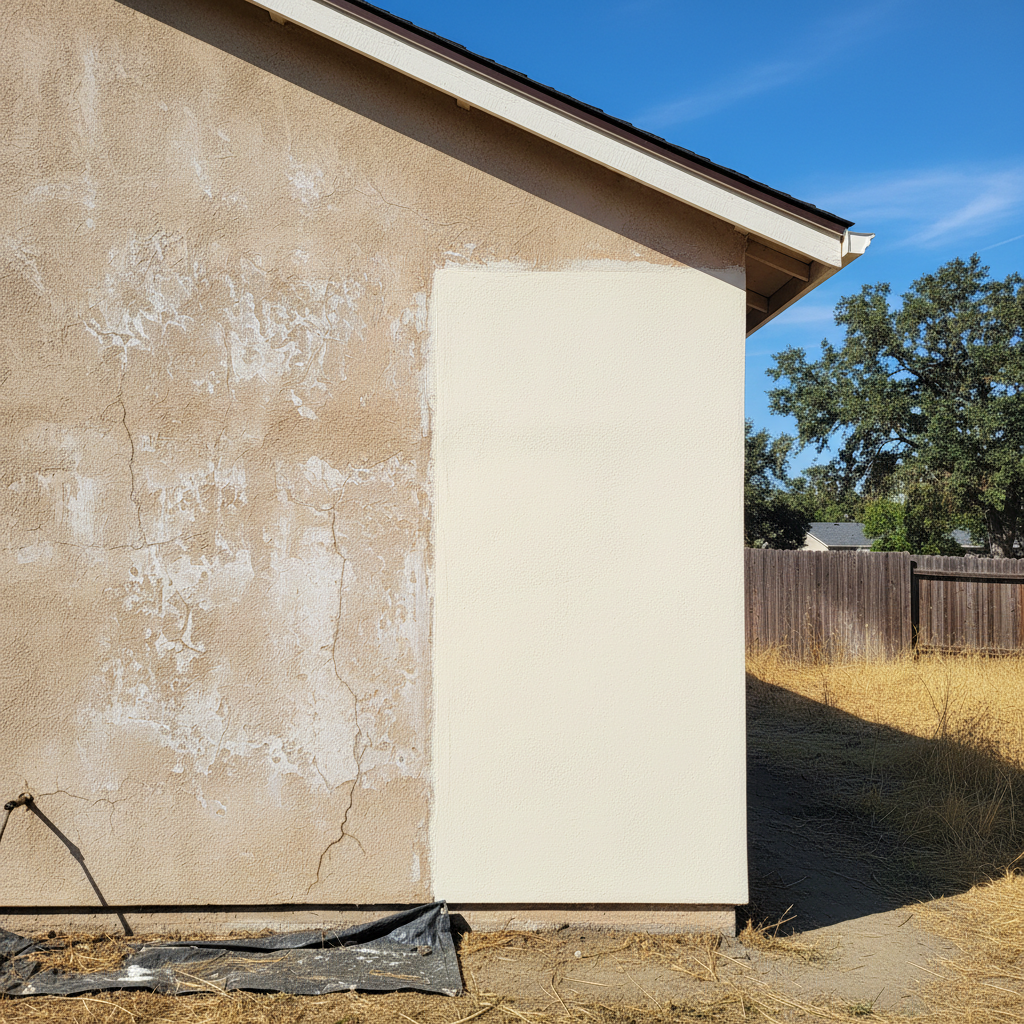
Alright, let's talk about replacing your stucco. If you own a home here in Roseville, you already know our houses really take a beating – that scorching summer sun, then those heavy winter rains that sometimes just won't quit. When your stucco starts looking old, with cracks, bulges, or even water damage, you've got a big decision ahead: what kind of stucco are you going to put back on?
You'll probably hear about two main options: EIFS (that's Exterior Insulation and Finish Systems), often called synthetic stucco, and then there's good old traditional stucco. They might look pretty similar at first glance, but trust me, they're built differently and they perform differently too. Having worked with stucco in this area for years, I've seen the good, the bad, and the truly ugly sides of both.
What's the Real Difference?
Traditional Stucco: The Classic Choice
Most people picture traditional stucco when they hear the word. It's a material that's stood the test of time, made from a mix of cement, sand, lime, and water. We apply it in several layers over a lath—usually a wire mesh, you know—and it dries into a hard, rigid, breathable shell.
EIFS: The Modern Alternative
EIFS, or synthetic stucco, is a multi-layered system. It includes an insulation board, a base coat reinforced with mesh, and then an acrylic finish coat on top. It's really designed for energy efficiency and flexibility. Think of it like a cozy jacket for your house, complete with its own insulation.
Cost: What's Your Wallet Saying?
When you look at just the upfront material costs, traditional stucco can sometimes be a bit cheaper. However, the labor for traditional stucco is pretty intense; there are all those layers and the drying times involved, after all. So, the total installed cost might actually end up quite similar, or even higher for traditional, depending on your specific project.
EIFS generally has a higher initial installation cost. That's mostly because of the specialized materials and how complex the multi-layered system is, including that insulation board. But don't let that completely scare you off; we'll get to why that first investment could really pay off later.
Durability & Maintenance: Built to Last (or Not So Much?)
Traditional Stucco
- Durability: This stuff is really tough. It can take an impact and it's fire-resistant. If it's put in correctly, it can easily last 50 years or even longer. It handles our Roseville heat just fine, but because it's so rigid, it can crack if the house settles, the ground moves, or temperatures swing a lot.
- Cracking: Small hairline cracks are pretty common with traditional stucco. They often pop up from drying shrinkage or when the building shifts a bit. Tiny ones (under 1/16 inch) aren't always a huge deal, but they can let moisture in if you don't fix them. Bigger cracks, especially diagonal ones, could point to more serious problems.
- Moisture: Traditional stucco is porous, meaning it can soak up water. This isn't usually a problem as long as it can dry out. But if water gets trapped behind it—say, because of bad flashing or drainage—then you're looking at potential rot, mold, and even structural damage.
- Maintenance: It's generally pretty low maintenance. Mostly, it needs cleaning and timely crack repairs to keep that water out.
EIFS
- Durability: EIFS is known for being flexible. That makes it more resistant to cracking from temperature changes and building movement compared to traditional stucco. It's also lighter, which is a plus. On the flip side, it can be more vulnerable to impact damage, like punctures or dents.
- Cracking: While it cracks less often overall, EIFS cracks—even small ones—are a bigger worry than they are with traditional stucco. Even tiny cracks can let water get behind the system, and since EIFS isn't as breathable, that water can easily get trapped.
- Moisture: This is the big one for EIFS, truly. Early EIFS systems, especially older